Disability Employment: Sustaining performance in real-world conditions
Author: Michelle Peck
This article covers:
- Continuity of support
- A new tool is available
- The evidence shows video modelling changes outcomes
- A better way forward
The core challenge in disability employment is: how do we support people with an intellectual disability to build and maintain job skills - not just during training, but on the job… every day?
While disability employers are committed to balancing consistent support with business productivity, most workplaces still rely on verbal instructions, printed job aids in large folders and employee memory… So it is understandable that where a person has an intellectual disability or neurodivergence, performance can slip on the first day of real work, and over time. And this isn’t because the employee can’t do the job, but because the support that helped them learn the skills isn’t easy to access anymore.
We know what helps embed skills:
- seeing how something is done in clear steps
- practice a skill by copying
- the ability to revisit when needed
Yet this kind of support is less available when the real job starts - and even if available, reluctance to ask for continued assistance from a supervisor may prevent support from being accessed.
And the outcome? Usually it’s frustration and emotional struggle for the person with a disability, and significant impacts to individual and team productivity.
With continuity of support, people succeed
Neurodivergent workers report difficulty navigating ambiguous responsibilities, cognitive overload from multitasking, exhaustion from sustained social masking, and barriers to advancement due to informal workplace norms. A recurring theme is not lack of skill, but lack of structured support.
A successful employment placement requires skills to be trained effectively and then:
- performed independently
- repeated consistently
- sustained over time.
In many cases, we ask our employees with an intellectual disability or neurodivergence to remember and perform steps and skills within an ambiguous environment, without access to reinforcement. When that person to copy disappears, or the reference becomes a page in a folder, and when proactive support reduces - the foundations for consistent performance are no longer there.
A new tool is available
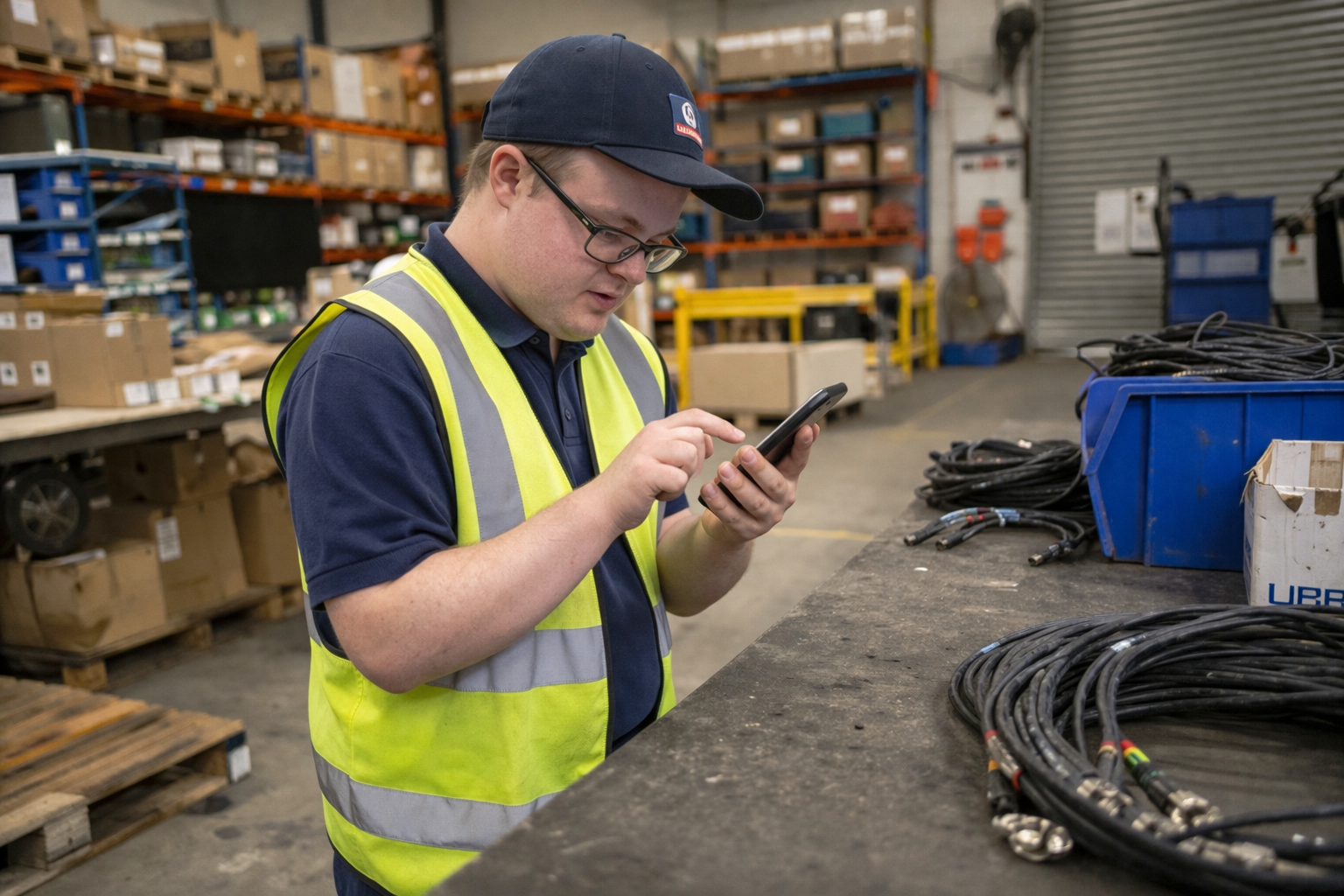
Taskey - a new app technology, is now available to extend the impact of job training for people with a disability or neurodivergent profile - and make skill reference videos easily available on their phone, anytime they need to refresh on a skill.
When expectations are unclear, performance becomes unstable. When reinforcement is absent, productivity collapses. Therefore, Taskey harnesses the power of video modelling and Video Self-Modelling (VSM) to support task execution, independence and consistency in a structured task on a digital platform.
With Taskey operating as the missing layer between learning and doing, people with a disability no longer need to struggle with applying trained skills on the job. They no longer need to rely on memory, printouts, or regular outreach to supervisors.
Employment trainers can quickly and easily record training as video modelled tasks on Taskey that the employee can watch between shifts and on shift to re-establish and embed each skill or step.
The evidence shows video modelling changes outcomes
Across disability research, one principle is consistently validated: visual, repeatable modelling outperforms abstract instruction.
Video-based interventions, particularly Video Self-Modeling (VSM), demonstrate strong outcomes: improved acquisition of multi-step tasks, increased independence in real-world environments, stronger retention and generalisation, and enhanced social and functional behaviours.
The mechanism is clear: modelling reduces reliance on memory, anchors behaviour visually, minimises ambiguity, and provides consistent reinforcement. Whereas training is transient, structured video-modelled tasks are persistent. Repetition and availability enables execution.
A better way forward
To bridge the gap between what is taught in supported environments and what is expected in real-world work, a new digital layer of reinforcement is proposed. Taskey operationalizes this layer by embedding evidence-based principles directly into daily workflows.
Taskey brings structure, clarity, and repeatability into the workplace by:
- making tasks visible on demand through real-world video-modelling
- reducing cognitive load by showing clear, step-by-step guidance
- enabling repetition to support consistency over time.
The question isn’t “Can this person do the job?” - it’s “Have we designed the conditions for them to succeed every day?”
Because when we do, capability and confidence grows and performance stabilises. And disability employment shifts from supported participation to sustained, meaningful productivity.